
Show summary Hide summary
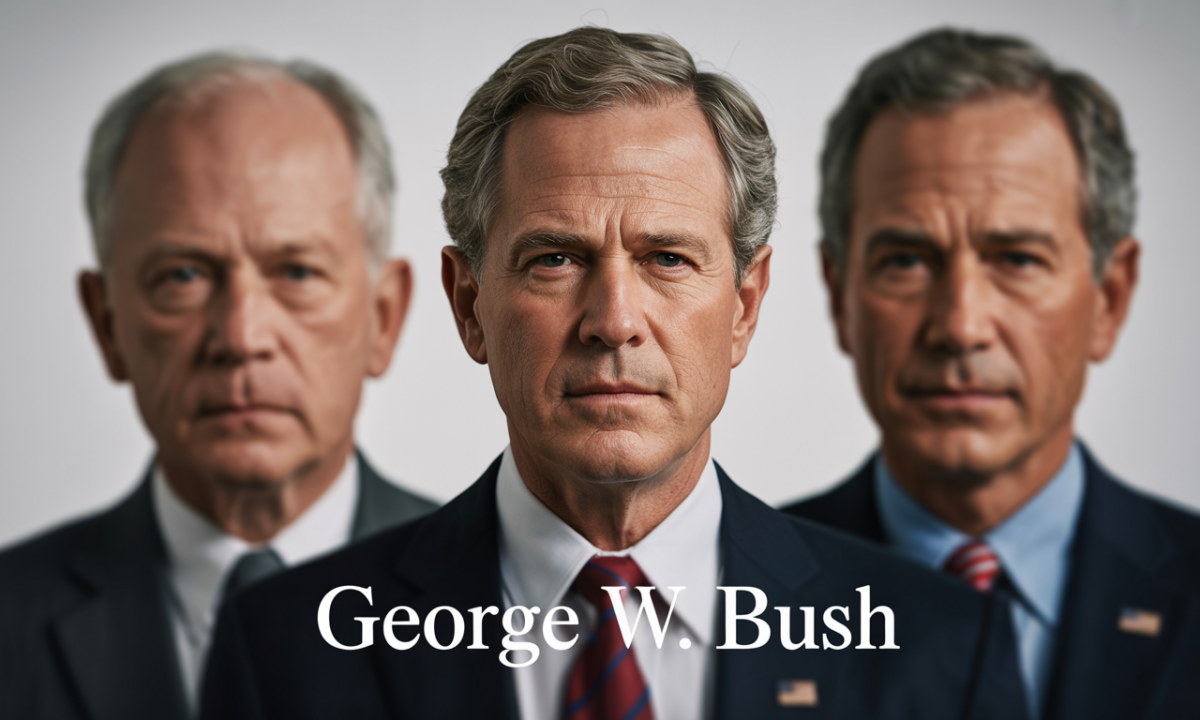
So, George W. Bush, that probably rings a bell, huh? Born on July 6, 1946 in New Haven, Connecticut, he is best known as the 43rd president of the United States. Yes, the guy was born into a family already deeply involved in politics — his father, George H.W. Bush, was also president, a real dynasty.
His path before fame is kind of a classic American story: he went to Phillips Academy in Andover, then Yale, where he earned a degree in history in 1968. You know, that elite atmosphere that prepares all its students a bit to make a mark on the world. He even had a brief stint in the Air Force, not bad for a young man whose family fortune was never far away.
It was from the 1990s that he really started to make a name for himself. Becoming governor of Texas from 1995 to 2000, he managed to navigate the Republican political game with some ease. But frankly, it’s his controversial victory in the 2000 presidential election against Al Gore — remember those Florida vote recounts? — that truly propelled him onto the global stage.
His age could make some doubt at the start, barely 54 when he began his first term in 2001. Can you imagine? Already linked to a comfortable personal fortune and the stature of a son of a president, he had to prove he had more to offer than mere family continuity.
George W. Bush, a statesman between heritage and ambition in Texas
George W. Bush is not just the son of George Herbert Walker Bush, former president. He is also a man shaped by the Texan lands where he grew up and governed. This Texan identity is central, a real marker to understand his political and personal choices.
Before the White House, he lived a rather quiet life, between oil companies and local politics. His size in the political world wasn’t dazzling but he managed to carve out a place by cultivating a pragmatic conservative profile. Yet, behind this sometimes somewhat simple look was a clear ambition, ready to face national storms.
George W. Bush’s career before his presidency
I must tell you, managing Texas was no small feat. Between oil industries and social issues, he learned to juggle. That’s where he matured, learning politics on the ground, often involved in discussions on taxation and security, topics dear to his later reputation in Washington.
At that time, his personal fortune also grew stronger, thanks to his oil businesses, even if at times it raised questions about the line between private interests and public service. But you can’t say his youth was a smooth ride: many doubted his ability to really take over his father’s torch.
The major successes, challenges, and controversies of his presidential career
Two terms at the helm of the United States leave a mark. If you remember, he was thrust into the spotlight after the September 11, 2001 attacks — a moment when he went from “accidental” president to wartime leader against terrorism.
I won’t tell you the impact on the population, which saw in him a man ready to defend his country at all costs. Afghanistan, Iraq, the famous “war on terror,” that was his daily reality. His tough talk and his plan to cut taxes marked that period, even if it brought a lot of heated debates, especially about the legitimacy of the interventions in Iraq.
Honestly, I think that period remains his greatest ordeal. Between fragile international alliances and human losses, there were many shadows despite some military successes. His second term, with the 2008 financial crisis, also didn’t spare his already shaky popularity.
George W. Bush’s private life and surprising anecdotes
Ah, private life! George W. Bush married Laura Welch, a woman he often describes as his true pillar. Together, they have two daughters, and their family life is often highlighted to contrast with his heavy public responsibilities.
One thing you may not know is that he was rather clumsy with painting, and he took it up after the presidency, revealing an unexpected artistic side. Kind of funny when you think about the military decisions he had to make!
Recent projects and notable collaborations of George W. Bush
Over the years, George W. Bush has turned to charitable works, involving himself in the Bush Center in Dallas, a space dedicated to political reflection and history. He collaborates with various figures, often with politicians, to promote civic engagement.
In 2026, even if his fortune is no longer a hot topic, his influence persists in certain Republican circles, especially through his public interventions and writings. After the White House, despite criticism, he remains a symbolic figure to study in order to understand contemporary America.
- 🎯 Governor of Texas from 1995 to 2000
- 🎯 43rd president of the United States, 2001-2009
- 🎯 Initiator of the war on terror
- 🎯 Strong controversy related to the Iraq war
- 🎯 Involvement in post-presidency projects
You got it, George W. Bush is a complex character, between political heritage and significant historical events. His impact is still debated but no one can deny his role during a particularly troubled American decade.
His age is advancing, of course, but his story still interests many, especially those wanting to understand the geopolitics of the 2000s. The size of his fortune and his place in this American dynasty show that inheritance issues are far from trivial.
In the end, following George W. Bush’s path is a bit like opening a detailed chapter of contemporary American history. He’s not perfect. He made mistakes. But his journey still resonates among current debates, especially for those interested in the role of the United States in the world.
If you want to know more, feel free to take a look at this encyclopedia or explore the detailed biography on Evene.