
Show summary Hide summary
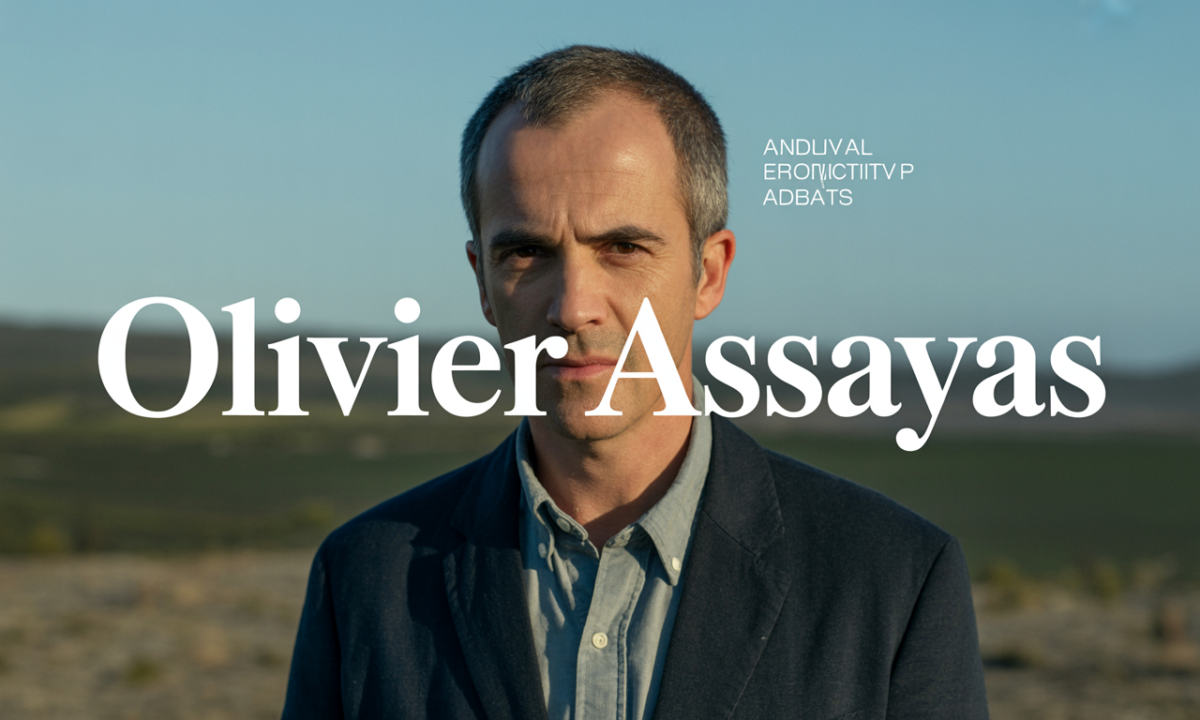
Olivier Assayas, an essential filmmaker of French cinema
Born on January 25, 1955, in Paris, Olivier Assayas is now 71 years old. When you look at his career, you are struck by the precision and boldness with which he has navigated the eras of cinema. I must admit it’s fascinating to follow a director who never stops surprising.
His name resonates in contemporary cinema circles: passionate critic, visionary director, and screenwriter with multiple collaborations, Assayas carries a unique sensibility that soothes his work and distinguishes him.
Basically, he is an artist who, since his youth, has kept his eye on modernity, always in search of new expressions that speak to our time and its paradoxes. A rich career, far from linear, where everything seems to fit together in an almost organic way.
This blend of authenticity, curiosity, and a rather raw view of society is what makes his artistic fortune far from stable – it grows with each film, with each risk taken.
Who is Olivier Assayas? Origins and public identity
Olivier Assayas is first and foremost a guy born into a family of artists and intellectuals. His father, Jacques Rémy, a famous screenwriter, and his mother, a decorator of Hungarian origin, laid the foundations of a prolific cultural universe.
He grew up in the heart of Paris, between painting and literature, which perhaps explains his way of blending arts and emotions in his films. Moreover, his studies at the Beaux-Arts and the Sorbonne remain a key stage before he decisively leaned towards cinema.
What we see in public is this mixture of discreet elegance and deep passion, far from flashy stars. Yes, he is a great man of French cinema, but with a naturalness and humility that is almost refreshing.
And then, his taste for popular cultures, like rock or Asian cinema, truly sets him apart, especially when you know his career as a critic for Cahiers du cinéma and Rock & Folk. It changes everything.
The young Olivier before fame: critic and discovery
Ah, his youth, it’s that time when he was everywhere but always at the heart of cinema. Imagine a guy in the early 80s writing for Métal Hurlant, Cahiers du cinéma, and Rock & Folk. Incredible, isn’t it?
He wasn’t a director yet, but the scene was already ready for him. His love of Asian cinema, notably kung-fu, would mark his work later. And then, as a critic, he had the freedom to gauge all styles, which forged a sharp eye.
This mix of openness and rigor sets the tone from the start: Assayas is not there to do the déjà-vu. His first directing experiences began with short films, but the real trigger was his first feature in 1986, Désordre.
And frankly, Désordre is no laughing matter. It explores the difficulty of the transition to adulthood, with a camera that’s almost chilling. You see a young filmmaker who doesn’t give up, it’s raw, unvarnished.
Career and great successes: a trajectory full of surprises
His filmography speaks for itself: from Désordre to Personal Shopper, through Irma Vep or Carlos, we are dealing with a filmmaker who likes to test all genres and not confine himself.
Irma Vep, for example, this hybrid film, became cult thanks to its blend of homage to Feuillade and Hong Kong cinema, with Maggie Cheung in front of the camera. By the way, their private relationship nourished this period, which gives a very intimate side to the project.
We can also mention Carlos, which tore down the boundaries between TV and cinema with its 5 hours and 30 minutes of story about the mercenary. It’s never been done before and earned him a Golden Globe, not insignificant!
Of course, he also won the directing prize at Cannes for Personal Shopper, proof that even at an advanced age, he remains that master who knows how to charm a jury. His personal fortune? Let’s say it finds its essence in his work and huge influence.
Private life, marriages, and children: a part of intimacy revealed
In his private life, Olivier Assayas is a discreet man whose heart has known some great stories. Briefly married to Maggie Cheung, with whom he shared a beautiful artistic and human period, they divorced after a few years.
He also had a long relationship with director Mia Hansen-Løve, with whom he has a child. Fifteen years together is no small thing, and it surely nourished his vision of human relationships that he often films.
He’s not the type of star to flaunt his life, but the little we know adds a nice depth around a guy who remains above all a passionate professional.
I think this intimate life, between confidences and respect, feeds his way of depicting complex relationships, whether romantic or social.
Recent projects and notable collaborations of Olivier Assayas
In recent years, he has not rested on his laurels: after Cuban Network in 2019, which brought together Penélope Cruz, Gael García Bernal, and Édgar Ramírez, he continues his exploration of thrillers and complex drama.
There is also talk of Le Mage du Kremlin in 2025, a promising project with Sylvester Stallone and Rachel Weisz. Honestly, such a cast can’t leave anyone indifferent.
At the same time, he relaunched the Irma Vep series in 2022 for HBO, revisited in a more contemporary version, a sign that at his age, he remains fully in touch with the new generation and digital platforms.
He also often collaborates with notable actors and directors like Juliette Binoche or Kristen Stewart, proof that he knows how to keep contact with talents that matter today.
A cinema of the moment and modernity: Olivier Assayas’s trademark
What amazes about Assayas is how he captures youth, even at 71. Yes, he often talks about youth, violence, and disenchantment, but always with depth, a crazy humanity.
His films are never fixed; they evolve with time, as shown by his work on Après Mai, where he revisits post-68 nostalgia, or his essays on technological and social changes.
Frankly, here is someone who mixes poetry and hard realism, shaking up the codes to draw out something truly personal and contemporary.
And that, in French cinema, is precious, at the heart of an industry sometimes tempted by standardization.
How Olivier Assayas has influenced French and world cinema
It must be said, Assayas gave new breath to French cinema of the 80s and 90s, with this sharp view on youth and society.
I confess that his mix of genres, his eclectic culture (kung-fu, rock, nouvelle vague) clearly allowed French directors and even international ones to break away from beaten paths.
Figures like Arnaud Desplechin obviously owe him a lot, but also talents less obvious at first glance, fascinated by his universe and tenacity.
It’s this face of a cinema both intellectual and pop, both critical and tender, that continues to make an impact far from traditional spotlights.
Some surprising anecdotes about Olivier Assayas
- 🎬 The film Irma Vep was shot in one month, with a very small budget, an achievement that shows his sense of resourcefulness and inventiveness.
- 🌏 He was one of the first critics to take an interest in Asian cinema in Europe, publishing a special issue on this topic in Cahiers du cinéma.
- 🎥 The extended version of Carlos, over 5 hours, was screened at the 2010 Cannes Film Festival, a rare event for a TV movie.
- 📚 Assayas also directed issues on Guy Debord, showing his intellectual side passionate about cultural movements.
- ⭐ His Cannes award for Personal Shopper was his first prize at this prestigious festival, which surprised many who were already following his career.
The rich filmography composing Olivier Assayas’s career
- 🎞 Désordre (1986)
- 🎞 L’Enfant de l’hiver (1988)
- 🎞 Paris s’éveille (1991)
- 🎞 Une nouvelle vie (1993)
- 🎞 L’Eau froide (1994)
- 🎞 Irma Vep (1996)
- 🎞 Fin août, début septembre (1998)
- 🎞 Les Destinées sentimentales (2000)
- 🎞 Demonlover (2002)
- 🎞 Clean (2004)
- 🎞 Boarding Gate (2007)
- 🎞 L’Heure d’été (2008)
- 🎞 Carlos (2010)
- 🎞 Après Mai (2012)
- 🎞 Sils Maria (2014)
- 🎞 Personal Shopper (2016)
- 🎞 Doubles Vies (2019)
- 🎞 Cuban Network (2019)
He has also contributed to documentaries and short films, showing his passion for all forms of expression.
Olivier Assayas in the digital world and contemporary media
I find it crazy that a director of his generation is still fully involved in new uses, such as the Irma Vep series on HBO or the many platforms that broadcast his works.
His presence at modern festivals and his stances, like in 2018 with Juliette Binoche for the climate, show that he is not just an artist but also an engaged citizen.
You can easily follow him on sites like Allociné or Popcinema, where his interviews and analyses reveal a passionate and curious man.
This dialogue with his audience, these exchanges around his work, may be the key to understanding that his age is not a barrier, on the contrary.