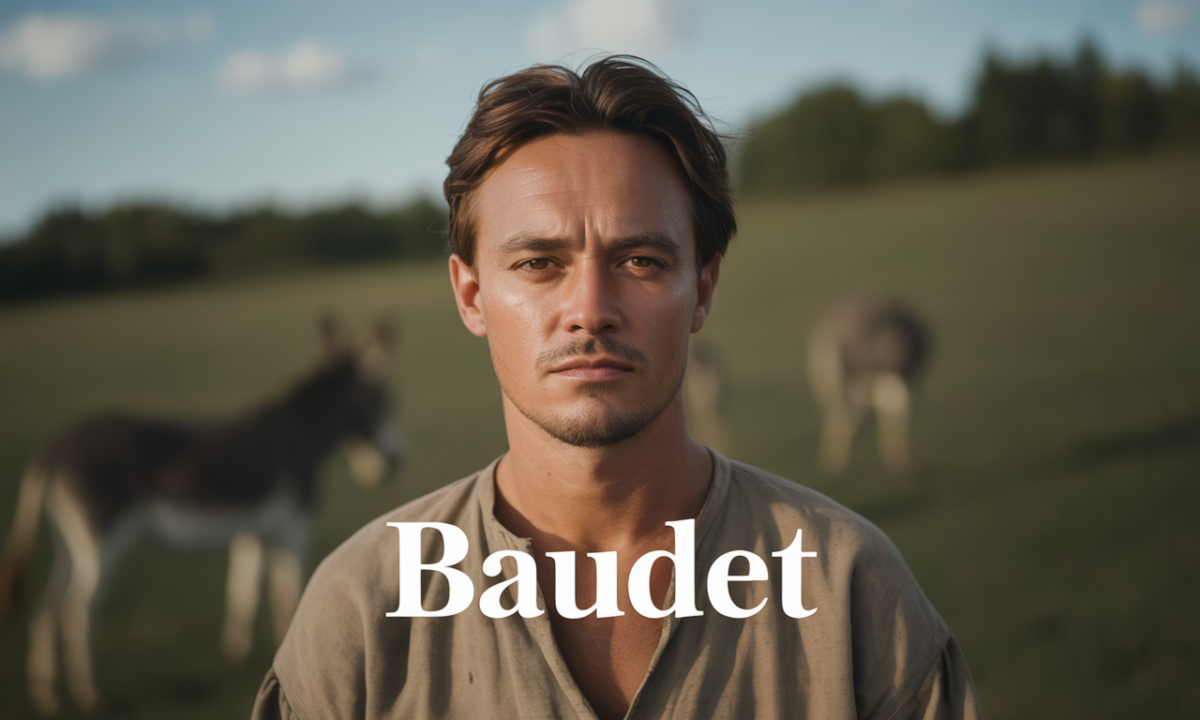
The Baudet name is one of those names you sometimes hear in conversations without really knowing where it comes from. I often wondered if it had a connection with the animal because, to me, a baudet is a donkey, a bit rustic, a bit sturdy. And then there’s this expression, “crier haro sur le baudet,” which has always intrigued me.
It’s crazy how such a simple word often hides complex stories. A bit like those last names we hear while wondering if they are just ancestors’ nicknames or if there is a real story behind them. With Baudet, it’s the same; you feel there’s something ancient, a rural landscape, traditions that have been imprinted over time.
I also enjoyed thinking about the place of this name in popular culture. It has that somewhat familiar, slightly rural side, but at the same time, it appears in more serious contexts, with historical figures or artists bearing this name. It surprised me, I must admit.
What’s funny is that Baudet is not limited to just a last name. It’s also a term for a tool, an object that sawyers used long ago. You can feel the old artisanal France, the one of almost forgotten professions, in this word.
So, here you go, I thought it was worth learning a little more, digging into this story, because every last name hides a bit of soul and memory, right? So, I’m taking you along with me on this little journey into the heart of the name Baudet.
What is the origin of the last name Baudet?
So, for Baudet, we really go into the old and rural register. This name clearly comes from a term that designated a donkey, yes, that robust animal that accompanied generations in agricultural work. In fact, Baudet is a familiar word that was used for a long time specifically to name a male donkey, a breeding donkey, which immediately shows the link with the countryside world.
The big question is why an animal like the donkey would become a last name? Well, as often happens, it’s one of many nicknames that end up imposing themselves as a surname. Perhaps an ancestor had a stubborn or determined character, or he worked with these donkeys daily. It is also possible that a simple nickname eventually became hereditary. This is quite common in medieval last names.
You should also know that the word Baudet has several uses that are just as old. For example, it designated a “strong trestle,” a tool or support to place tools or wooden beams. This link with manual and artisanal work confirms that the Baudet family could have origins connected to rural trades or woodworking.
I admit that everything is not perfectly clear because this name has probably evolved depending on the regions. But the general idea remains that of a solid, popular root, directly connected to peasant life and its objects, its essential animals.
The meaning of the last name Baudet, between animal and tool
What’s fascinating about Baudet is precisely this balance between the animal and the object. The primary meaning is surely the donkey, that somewhat grumbling but essential French “donkey.” And then, there is that famous expression “crier haro sur le baudet,” with the idea that the baudet is a scapegoat, the one on whom we wrongly take out our anger.
The image of the baudet as the scapegoat is quite strong. Jean de La Fontaine talked about it, and maybe that also helped keep this name in collective memory. A baudet is both a work companion and somewhat the victim of others. A dual symbolism that ultimately makes it very human.
So, naturally, carrying the name Baudet can evoke that notion of endurance, modesty, but also a little unloved side, which is not unpleasant to me when one likes last names with character. Some linguists also think that, as a last name, it could come metaphorically, qualifying someone as patient or stubborn… but well, it’s hard to be certain.
Where can you find the last name Baudet in the world today?
In France, Baudet remains a rather rare name but well established in certain regions, especially in the West and the Center, which corresponds quite well to rural areas where the donkey was a common working animal. It is also found a bit in Île-de-France, probably due to internal migrations.
Surprisingly, this name is not as common in some regions where the donkey also had a place, like the Southeast. This shows that it probably has a quite circumscribed origin, which can facilitate genealogical research if you have Baudet in your family.
Abroad, it is almost non-existent as a name, which suggests it is deeply rooted in French terroir, without really making the big leap internationally. Yet, some figures bearing this name have made an impact in culture or politics elsewhere, but that remains marginal.
Variants and spellings of the name Baudet over time
So the variants, there have been a few, but nothing completely crazy. Baudet remains Baudet, generally. Sometimes, you see somewhat old or slightly modified forms in registers, like Baudet or Baude, which could be diminutives or simplifications.
On the francophone side, the name keeps this simple and robust recipe. In other languages, one could compare Baudet to Becker (German), which is also a common name, but that’s clearly a different story… Yes, sometimes names that look similar come from completely different roots.
I also came across compound names, such as Baudet-Lafarge, which add a bit of complexity. Often, these compounds reflect family alliances or inheritances, and it’s always interesting to explore that when doing genealogy.
The famous personalities who bear the name Baudet
Ah, yes, there are a few who have brought this name out of the ranks of the anonymous. For example, Étienne Baudet, a 17th-century French engraver, who marked his era. That shows we are far from the pure and simple rustic image.
You may also know Thierry Baudet, a Dutch conservative essayist, a contemporary figure with strong opinions, which gives another spotlight on this name.
There was also in sports Julien Baudet, a French footballer, and Teddy Baudet, a racing driver, names that appear in very varied spheres. Charles Baudet, meanwhile, a French doctor and mayor, recalls the social and political significance this name has also had.
In short, Baudet is not just a rural name; it is a name that has crossed centuries with very different profiles. And that’s what’s enjoyable.
Some tips to start your genealogical research on the name Baudet
If you have Baudet in your family tree, don’t be discouraged by the apparent rarity. Start by looking at the departmental archives of the West and Center regions to narrow down places of origin. Civil status records, especially those from the 19th century, are often well preserved and valuable.
Also look at professions: sometimes you can find clues if an ancestor was a sawyer, farmer, or had a connection with rural life. The fact that Baudet also refers to a tool gives you a craft clue that could be confirmed in notarial deeds or particular registers.
Don’t overlook variations of the name in old registers; that could open new avenues. I also enjoy digging into parish registers, sometimes richer than civil records for older periods.
Some statistics and anecdotes about the name Baudet
| 📍 Region | 📊 Estimated number of bearers | 🔍 Particularities |
|---|---|---|
| West of France | About 1,500 | Very attached to the countryside, rare in urban areas |
| Center of France | About 700 | More marked rural origins |
| Île-de-France | About 300 | Recent presence linked to migrations |
For a not-so-common name, Baudet has nevertheless managed to cross the ages without fading too much. We notice that unlike other names, it hasn’t really exploded in popularity, but it remains firmly anchored, which is rather rare nowadays.
Finally, a funny anecdote: in old expressions, “crier haro sur le baudet” meant to cry foul by accusing the poor innocent, which says a lot about the symbolic charge carried by this name in popular culture!
The name Baudet thus balances between simplicity and depth, between a modest image and realities that go far beyond that. I hope this has made you want to discover more around you.
Curious to know if you now have Baudet in your circle. It adds a little extra soul to every meeting, doesn’t it?
So here we go, Baudet is a bit like that faithful donkey who keeps his place despite fashions and decades. A name that lasts, solid.