The name Benameur sounds a bit like an invitation to travel, doesn’t it? I must confess that the first time I heard it, it slipped by me a little. It’s not very common, yet it hides a rich history. I like those names that don’t reveal themselves right away, a bit mysterious.
You come across Benameur here and there, often in contexts related to the Maghreb or francophone culture. And frankly, it makes you want to dig a little: where does it come from? What meaning might this last name carry, surely filled with personal stories and sometimes even distant lands?
What strikes me is that this name seems to combine several cultures, from the Mediterranean and the Arab world. No wonder there are several stories to tell. I also discovered that it is not just a surname, but also a unique cultural signature, notably thanks to a literary figure who will be mentioned later.
I can well imagine a conversation with someone who bears this name: what connection to their family, what deep roots? It makes one think of these stories of exile, encounters, and mixtures. In short, Benameur sounds like the beginning of a never-ending story, to be told aloud over a coffee.
Ah, and to be honest, if you’re looking for an easy-to-pronounce or guess name, this one might give you a hard time. But it’s precisely this somewhat mysterious charm that makes it so endearing, don’t you think?
What is the origin and meaning of the last name Benameur
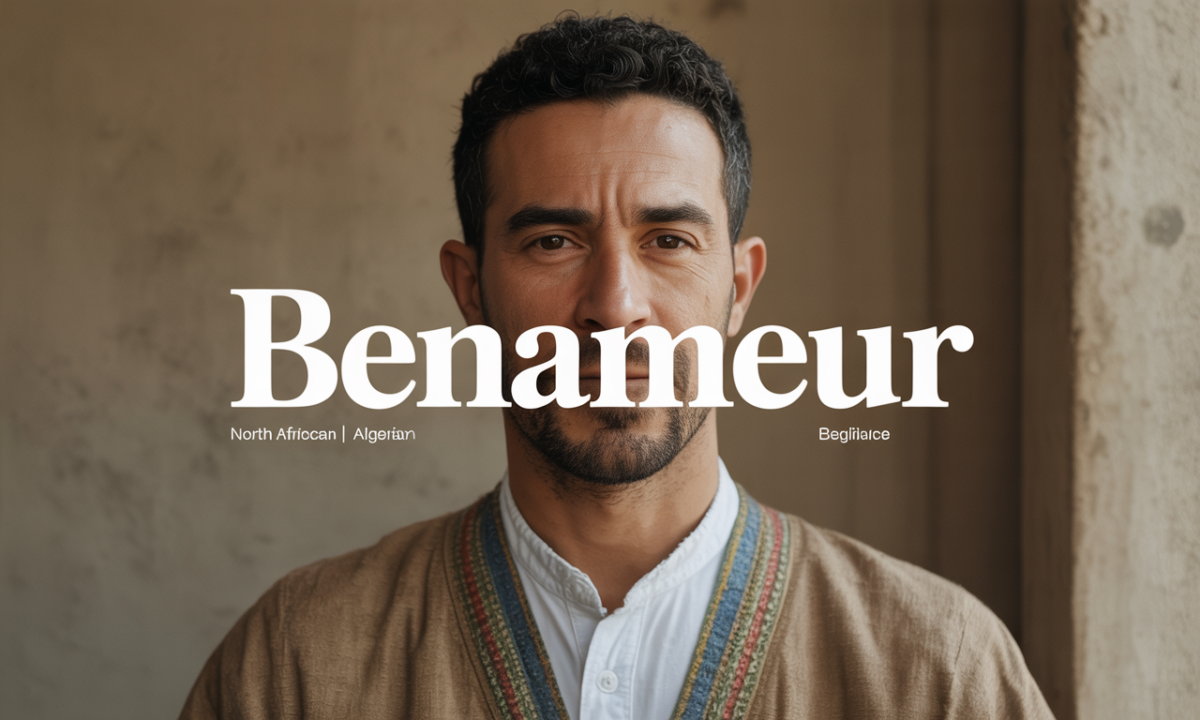
So first, Benameur sparks curiosity with its clearly Maghrebi sounds. You can immediately think of a North African origin, from Algeria or Tunisia. The prefix “Ben” which means “son of” in Arabic, indicates filiation, which is quite common in last names from the Arab world.
As for the rest, “Ameur” or “Ameur” would be a first name or a word that can refer to someone insightful or noble — even if it remains a bit vague, I admit. It’s a bit like saying “son of a noble man” or “son of a respected man.” Not bad for a last name, right?
We can also imagine that this name was adopted by families wanting to mark their origin or social status. In Berber and Arab societies, last names often carry strong identities, telling a story or heritage. That’s probably what happened with Benameur.
So yes, the Arab roots are clearly visible, but it also mixes a French cultural dimension as soon as this name arrives in France with immigration. I tell you this because Jeanne Benameur, who is well known, clearly illustrates this bridge between two cultures.
The meaning of the last name Benameur
OK, it’s not always easy to give a clear definition to a name like Benameur, but we understand well that it’s a mix of cultural elements. “Ben” is very well known for “son of.” This “Ameur” could come from the first name “Amir,” which in Arabic means “prince” or “chief.” So you see the picture: “son of the prince,” it sounds pretty strong.
But I admit that the phonetics may have evolved, that it’s not strictly “Amir,” maybe another variant. Sometimes in certain Maghrebi dialects there is a kind of lengthening or modification that leads to something else.
In the end, the name would carry an idea of origin and a noble or respected identity, which does not leave one indifferent. For etymology lovers, it opens a nice field of reflection, even if it’s never 100% certain.
Where is the last name Benameur found in the world?
You might say to me: “But where exactly is Benameur found?” Well, in France, this name is clearly linked to the Maghrebi community, more precisely Algerian and Tunisian. It’s a fairly discreet name, not in the top 50 or anything very common, but it appears mainly in cities with a strong North African immigration.
I think mostly of Paris and its region. But also La Rochelle, since Jeanne Benameur spent her childhood there. This gives a fairly urban side to the name, associated with families who have crossed the Mediterranean and settled in quite diverse areas.
Overall, outside France, the name is mostly found in Algeria and a bit in Tunisia. Spain or other Mediterranean countries also host it, but it’s much less frequent. It’s as if the name has traveled through migration history, establishing itself while remaining somewhat rare.
Variants and spellings of the last name Benameur
Honestly, with a name that goes from one language to another, you expect to see lots of variants. For Benameur, it remains quite stable, but there are some adaptations. Sometimes you will come across “Ben Ameur” with a space, which recalls the classic Arabic style, or even “Benameur” without a space but with slight differences in pronunciation.
There are also spellings where the “u” becomes a bit more Frenchified or accents are forgotten, especially in official European registers. No crazy transformations though, the overall identity is well kept.
Well, it’s not like “Becker” that can become “Bäcker” or “Bakker” with lots of variations depending on the countries. Here, it’s rather straightforward, and it retains a lot of the original Arabic root, which is rather reassuring.
Famous faces with the name Benameur
Ah, this is one of the strong points. Jeanne Benameur, of course, the French writer born in 1952 in Algeria, who embodies all the richness of this name. Coming from a mixed family with a Tunisian father and an Italian mother, she has crossed several cultures, which echoes the origin of the name Benameur.
Jeanne is not only famous for her name but for her dense, engaged, sensitive literary work. Books like “Les Demeurées” or “Vivre tout bas” testify to her ability to handle the French language with deep poetry, a lucid view of the world. She has several literary awards to her credit, she is a true figure.
Her journey, from childhood in Algiers to life in France, gives this name extra soul. In 2025, she remains a reference often cited in literary discussions about crossed identities.
How to research ancestors bearing the name Benameur?
If you have Benameur in your family tree, an interesting lead is to look towards Algeria, especially in regions close to Tunisia. The French colonial history played a big role there, with strong migratory links between these countries and France.
A nice tip would be to search archives between the 1930s and 1970s, a period of intense migratory movements. La Rochelle, for families settled in France, can be a cornerstone. Also, try the civil status registers of French departments where the Maghrebi community is present.
I would also add that the research could be enriched through school records, municipal records, or even oral stories passed down in families. These transmissions are worth their weight in gold, especially when the history is complex.
Some statistics on the name Benameur in 2025
So, today in France, Benameur is not a very widespread name, but far from unique. It is estimated to have several thousand bearers, mostly in large urban areas. The name doesn’t appear among the very top, but maintains a notable presence without exploding either.
What is interesting is that since 2000, there has been a slight increase, probably linked to new generations and the maintenance of cultural roots in families. There is a feeling of attachment to the name, to the identity it carries, even face to assimilation.
In summary, Benameur is a name that knows how to remain discreet while carrying a strong story, both intimate and collective, that’s part of its charm, don’t you think?