
Show summary Hide summary
The name Saunier, I sometimes see it passing by, especially when talking about salt, salt marshes… You know, that little miracle of nature turned into white gold by ancestral know-how. Honestly, it has always made me think of a job unlike any other.
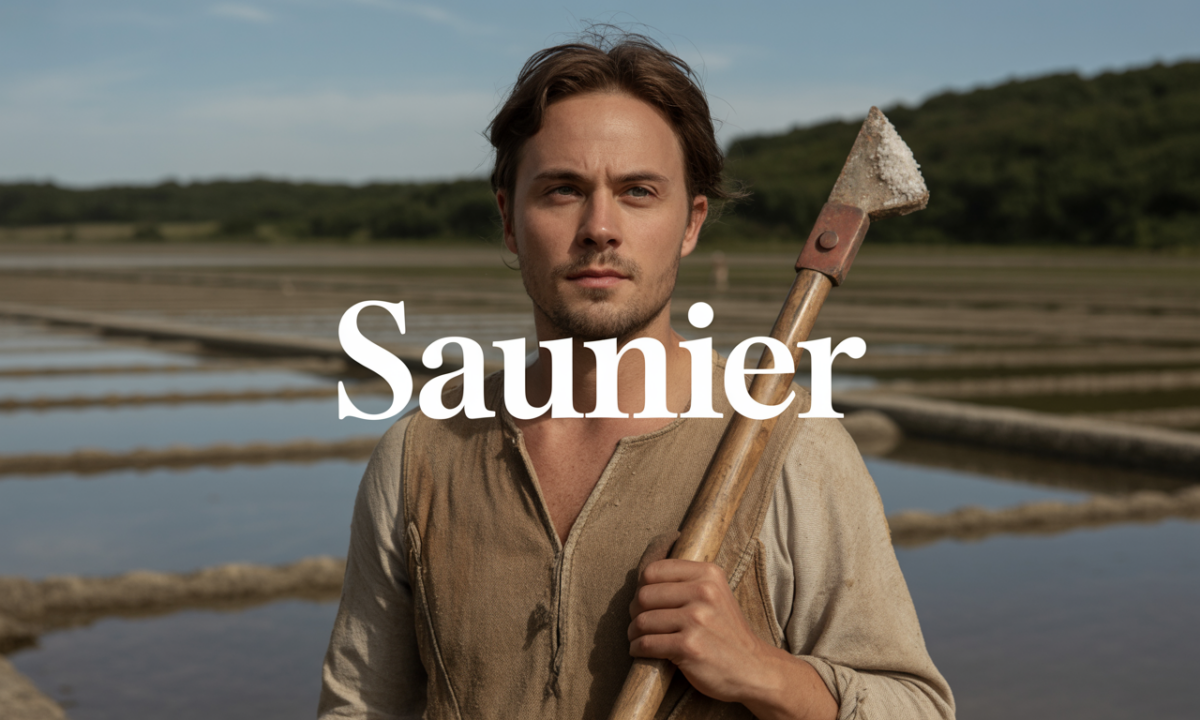
I often imagine a guy by the water, his back slightly bent, with the sun beating down to evaporate the salty water. That Saunier is more than a nickname, it’s a career, a family story, almost a passion. Not so simple to master salt, believe me.
And then, there’s that old thing, that important role under the Ancien Régime, where a Saunier didn’t just collect salt but sold it. It smells like struggle, smuggling, the salt tax… I admit, it’s a name that carries weight, some mystery too.
Digging deeper, you discover a real tradition, sometimes harsh, always respected. The name Saunier evokes a physical, almost magical trade, the one who makes salt come to life from water. A beautiful story of balance between nature, human work, and patience.
I have sometimes wondered if today’s Sauniers are a bit like those from the past, with their gestures passed down generation after generation, that almost intimate contact with the marshes, the salty air, and the wait for the perfect grain of salt.
What is the origin and meaning of the last name Saunier
The name Saunier has roots in the world of salt, yes, naturally. It comes from the medieval Latin salinarius, a term that designated one who made or sold salt. But beware, it was not just a merchant, it was often someone working in salt marshes, carefully managing the harvest. It’s surprising to see how much a name can keep this direct connection to an old trade.
References date back to the 12th century, where the Saunier was the person authorized to sell salt, an essential but also highly controlled product by the authorities. Under the Ancien Régime, salt was heavily taxed, known as the salt tax, the famous gabelle. This context gave rise to figures like the false saunier, who was a smuggler. So if you have Saunier in your family tree, there might be a rich story to tell.
The meaning of the last name Saunier
The Saunier, in essence, is the one who shapes salt. It’s not just a seller, it’s a true craftsman who knows how to manage the water, the basins called œillets, the seasons, everything to transform seawater into salt crystals. Well, it’s not always easy to explain, but I’d say it’s a mix between a field engineer, a farmer, and a salt artist.
Salt here is not just a product, it’s a piece of nature mastered with patience. The Saunier must perfectly know the climate, the tides, and avoid the rain that can spoil the harvest. I like to think that the name Saunier carries a bit this idea of balance between nature and the human hand, it’s beautiful isn’t it?
The geographical distribution of the last name Saunier in the world
So, in France, Saunier is mainly found in the West, which surprises no one given the importance of salt marshes in this region. Think of Loire-Atlantique, Vendée, Charente-Maritime. These coastal areas are a bit the cradle of the Sauniers, where the trade still truly exists.
In other French-speaking countries it also exists, but the name is really rooted near the sea, near the land. It’s not an urban last name or common in traditional large cities. It’s also found a bit in countries with a salt production tradition, but under other spellings.
Variants and spellings of the last name Saunier
Ah, the variants, it’s always funny. You will sometimes find the form Saulnier, quite close, which almost gives the impression of a different pronunciation depending on the regions. In Old French, it is sometimes written Salinier, which is a somewhat more “scholarly” form and closer to Latin, and which also designates the salt maker.
As for foreign countries, in Germany for example, you will find Sauniers under names like Saliner or Salzmann (the man of salt), but that remains a bit separate. In any case, for the French Saunier, the spelling has been quite stable for several centuries, which clearly shows the importance of this trade in family transmission.
Famous personalities bearing the last name Saunier
Well, it’s not a very common name among celebrities, but some historical or contemporary figures proudly bear this last name. It’s not on the showbiz or mainstream sports side that you find them, but more in fields related to the science of salt sometimes, to the preservation of marshes, or even to regional literature.
For example, one could mention environmental activists who defend the Saunier traditions, or craftsmen who perpetuate this ancestral trade today. It’s not a last name on everyone’s lips, but it often evokes deep respect for nature and ancestral know-how.
Ideas for genealogical research around the name Saunier
If you have this name in your tree, think of the archives of the salt marshes of the West, especially around Guérande, Noirmoutier or Camargue. Notarial deeds related to the sale or exploitation of salt are often a gold mine to trace Sauniers, especially between the 14th and 19th centuries.
I also advise you to look at parish registers in coastal villages, because where there is salt, there is inevitably a Saunier or a Saunière. Oh, and don’t hesitate to explore the historical contexts of the gabelle, the very unpopular salt tax, which left many traces in judicial archives for those who smuggled.
Some commented statistics on the last name Saunier
| 📍 Region | 📈 Frequency | 📉 Trend | ✨ Note |
|---|---|---|---|
| Loire-Atlantique | Very common | Stable | Main historical hub |
| Vendée | Fairly common | Slight decline | Old Saunier families |
| Charente-Maritime | Moderate | Stable | Near salt marshes |
| Île de France | Rare | Increasing | Recent migratory movements |
This table shows that the Saunier remains primarily well rooted in its original territory, especially in western France, which confirms that it’s a name closely linked to a region and a trade, to the point that it has become almost a local symbol.
However, with modern mobility, it is no longer rare today to find Sauniers in big cities. This phenomenon gives the name a new life, far from the salt flats but with the same strong identity.
And if you want to feel the atmosphere of the Saunier trade a little, this video takes you into salt marshes, with precise, simple gestures worthy of centuries-old know-how. It’s fascinating to watch, you’ll see.
Another view, more focused on cultural heritage and family transmission, this video shows how modern Sauniers perpetuate this trade respecting traditions, while adapting to our current ecological challenges.
- 🌊 The Saunier works with water, air and sun
- 🧂 The trade relies on ancestral and artisanal know-how
- 👴 Often passed down from generation to generation
- 🌍 Mainly concentrated in the West of France near the marshes
- ⚖️ History linked to the gabelle and salt smuggling
Saunier evokes much more than a name: it’s an occupation, a living heritage, a precious art of patience and attention. It’s undeniably a name with charm and character, isn’t it?
So, if you have this name, you may have ancestors who contributed to a piece of history, to that little treasure which is salt. No wonder the Saunier is respected, sometimes even a bit mystical, in coastal regions.
I find it to be the perfect example of a name carrying its weight of history and nature, telling stories of man and sea, patience, tradition. Not just an ordinary last name like any other.
In 2026, with the growing interest in artisanal trades and local heritages, the name Saunier continues to shine in its modesty, faithful to its saline roots and to those craftsmen who still make salt a way of life today.