Show summary Hide summary
- What is the origin and meaning of the last name Vacher?
- The meaning of the last name Vacher according to etymology and sources
- The geographical distribution of the name Vacher worldwide
- Variants and related forms of the last name Vacher
- Famous personalities bearing the last name Vacher
- Tips for your genealogical research around the name Vacher
- Some interesting statistics on the name Vacher in 2026
The name Vacher is a bit like a rustic breeze in your family history, don’t you think? I believe that behind this simple name lies a real little village life. Personally, every time I come across it, I immediately imagine the meadows, the herds, that kind of rustic things that are good for the mind.
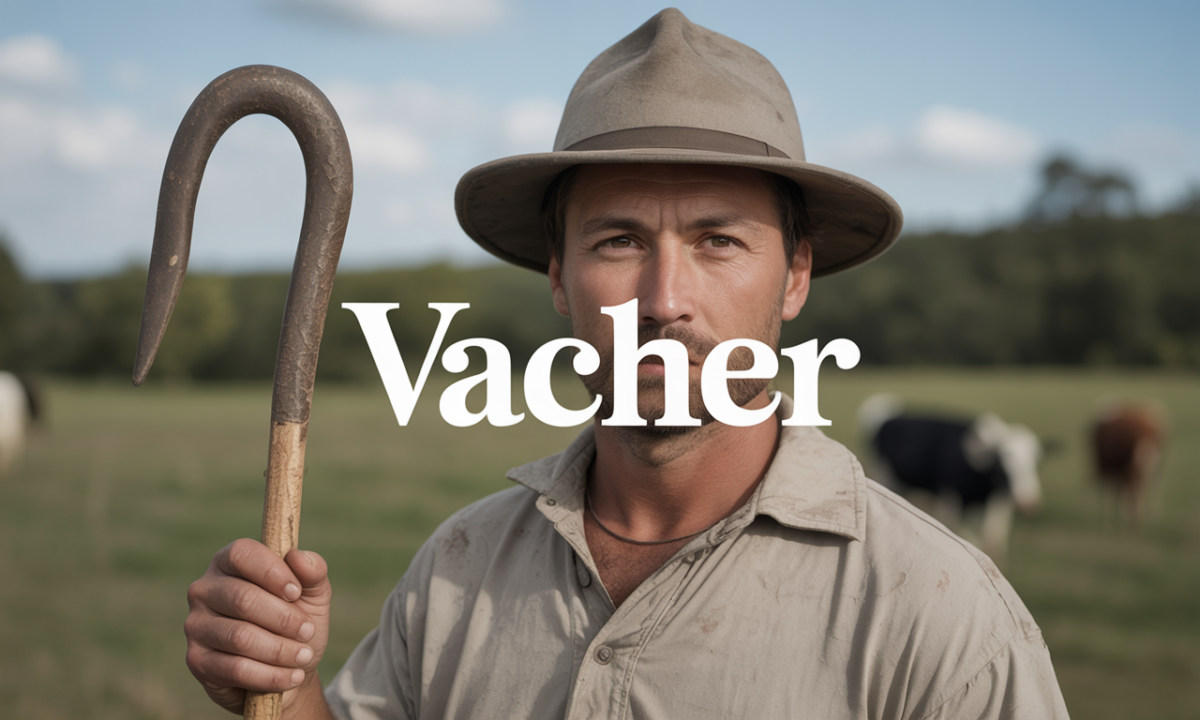
I have always had quite a strong image of Vacher as the one who takes care of the cows, not very far from the cowherd, you see? And the sound, a bit round, almost carries you into the atmosphere of the fields and farms. Honestly, it has a reassuring, almost tactile aspect.
But then, how did this name come to designate families? Is it simply the same job that ended up becoming a last name? Or, you know, a type of nickname as was done in the Middle Ages? I admit, I’m not an expert, but the subject has fascinated me for a long time.
It is also a name that, I find, tells a story of an agricultural past that marked French society. I even read that some bearers of this name might have roots much older than one might imagine at first glance. Just that!
So, let’s go together to discover the name Vacher and its history. It’s amazing what a name can tell when you seriously listen to it.
What is the origin and meaning of the last name Vacher?
The name Vacher most likely comes from the popular Latin vaccarius, which itself derives from vacca, the cow. This term passed into Old French in the form vachier, attested as early as the 12th century, to designate the person who took care of herds of cows. Yes, it’s as simple as that, although you can sometimes find regional variants, like in Occitan where one speaks of vaquier.
This professional origin is consistent with medieval practices where names often formed from a person’s profession or social role. A Vacher was thus literally the one who led the cows to pasture, who guarded and cared for them. I find that quite touching, like a direct link to the work of the land and livestock that structured rural life for centuries.
There is also an interesting linguistic dimension: the term is close in other Romance languages, such as Spanish vaquero or Italian vaccaro, which shows well that this profession was everywhere a pillar of rural economies. It creates a kind of rural universality in this name, doesn’t it?
Well, some somewhat older sources also mention that Vacher could have been used pejoratively, designating a rough or coarse person. But that is another story, more social and more linked to urban representations of the countryside.
Basically, it’s a name deeply rooted in the peasant imagination, with a heritage easily going back to medieval times, where living to the rhythm of animals was the daily life of many.
The meaning of the last name Vacher according to etymology and sources
At its core, Vacher clearly means “the one who takes care of cows.” But it’s not just an old-fashioned profession, it’s also a term that evokes care, responsibility, a truly central role in livestock management. A kind of guardian of rural life.
There’s also an affectionate side to this name, because a vacher doesn’t just watch over; he cares for the animals, he knows them. The relationship between the vacher and his herd is almost intimate, a bit like a family bond. I love that idea, it immediately gives the name a warm, human feel.
However, this term sometimes, in literature and popular stories, takes on a slightly harsher tone. One speaks of “vacher language,” meaning a somewhat coarse, direct, no-frills way of speaking. This double facet seems very interesting to me because it adds a social layer to the name, illustrating the contrasts between respect for the profession and stereotypes.
As we see in some old texts, this term also sometimes evokes the man or woman of the people, a simple rural character, sometimes rough-mannered but often honest in his or her roughness. Which, in fact, makes it even more human.
Basically, Vacher is a name that carries within it both an economic function, a social image, and a very strong emotional connection to the countryside.
The geographical distribution of the name Vacher worldwide
The name Vacher is often encountered in France, especially in regions with agricultural and livestock vocations. It’s no surprise that it appears quite frequently in Burgundy, Auvergne, the Massif Central, but also in some parts of Île-de-France, sometimes linked to rural exodus and migration to the capital.
Elsewhere in the world, the name is less common, but traces can be found in French-speaking Switzerland and northern Italy, which makes sense given the linguistic and geographical proximity to France. On the other hand, unlike what one might think, it is rare in English-speaking countries, where the equivalent translates rather as Cowherd or Farmer.
That said, some bearers of the name have of course migrated, and today you can find Vacher in North America, especially Canada, but in smaller numbers. In 2026, the name still remains linked to its rural roots, even if bearers live all over.
For those who have Vacher in their family tree, it’s an interesting lead: targeting the rural areas with traditional livestock farming in central and eastern France can really help to find ancient traces.
In short, a distribution that also tells a living peasant story, not frozen.
Variants and related forms of the last name Vacher
So, for the name Vacher, there are some quite nice variants, often influenced by regional phonetics or neighboring languages. I downloaded a small list for you:
- There is Vachier, which is an old form, quite widespread especially in northeastern France.
- In the South, one sometimes finds Vaquier or Vacquier, very close to Provençal or Occitan.
- At the Italian border, the name can appear as Vaccaro or Vaccari in the Italian language.
- Further north, in German-speaking areas, a form like Wacher or even Bäcker (although the latter is more baker) may arise, often by phonetic analogy.
These variants show well how such a key profession left its mark with vocabulary that adapts to languages, while largely keeping its original meaning. In short, nothing rigid here, we are in linguistic flexibility and popular culture on the move.
Famous personalities bearing the last name Vacher
I bet you didn’t have them all in mind, but there are still some names that stand out. For example, Lucien Vacher, a former French rugby player of the 60s, known for his toughness and team spirit. Not super famous in all households, but essential among sports fans.
Then there is Philippe Vacher, a contemporary photographer who gained notoriety in 2020 for his shots of rural life and intimate portraits of peasants, which fits well with the name after all.
It’s funny to see that many Vacher remain attached, in one way or another, to professions or arts linked to the land, traditions, or simplicity, which is charming.
Tips for your genealogical research around the name Vacher
If you have Vacher in your family tree, here are some leads to get started. Ideally, start with rural and parish archives of central France, especially in Auvergne or Burgundy, where this kind of name had its golden age. Go dig through the civil status registers from the 1700s-1800s; they are often well preserved.
Also think about checking military registers, often rich in family information, as the Napoleonic campaigns saw many villagers go to the front. It’s not uncommon to find vachers enlisted there, which completes the picture.
And above all, don’t hesitate to question the elders, sometimes family stories and oral anecdotes can illuminate as well as official archives, or even better. Listen carefully to their way of speaking, they often keep the taste of the terroir and traditions no longer found in books.
For the record, genealogy with a name like Vacher is a straightforward adventure, no fuss, contact, patience, and a pinch of love for the terroir.
Some interesting statistics on the name Vacher in 2026
| 🏷️ Name | 📍 Most frequent region | 📈 Estimated number of bearers | 📉 Recent trend |
|---|---|---|---|
| Vacher | Auvergne-Rhône-Alpes | about 7,500 | stable / slight decrease since 2000 |
| Vachier | Grand Est | 1,200 | stable |
| Vaquier | Occitanie | 800 | slightly increasing |
We notice that the name remains overall stable, with a tendency to decline in its most classic forms. This can be explained by rural exodus and the modernization of families, but also by the diversification of last names over time. At the same time, variants like Vaquier show a local resurgence of interest, perhaps linked to a stronger regional identity.